
Visiting Dead Sea, Jordan | Where to Swim, Stay & Explore (Essential Guide)
A local guide to the Dead Sea in Jordan: best beaches and free swim spots, how to float safely, Pink Lake, Baptism Site, Panorama Complex, canyons, where to stay, and how to get there.
TRAVEL GUIDESJORDANRECENT


Whether you stay at a luxury resort, rent a chalet with a pool in Sweimeh, or just want a quick float at a local shoreline spot, the Dead Sea is one of those places that feels unreal until you’re actually there—standing at the edge, looking at the salt formations, and trying to understand how water can hold your body like a cork.
We live in Jordan and we visit the Dead Sea throughout the year—sometimes for a proper relaxing day, sometimes as part of a road trip heading south, and very often in winter when the rest of the country cools down and the Dead Sea area stays warmer.
It’s one of the easiest “reset” places in Jordan: you can spend a morning in the mountains near Madaba, then drive down into a completely different climate and landscape.
This guide covers everything you need to plan your Dead Sea visit: what the area is actually like, where to swim (including free spots), how to float without pain, what to do nearby (Baptism Site, Panorama Complex, canyons, hot springs), where to stay for every budget, and how to build the Dead Sea into a real itinerary instead of a confusing stop you rush through.
If it’s your first trip to Jordan, start with our Jordan Travel Basics before planning your route.


Why Dead Sea is so unique (and why you shouldn’t postpone it)
The Dead Sea is the lowest point on Earth, sitting far below sea level (408 meters bsl). It’s famous for its extreme salinity—which is why you float so effortlessly—but the bigger story is that it’s also one of the most dramatic landscapes in Jordan.
The descent from the highlands down to the shoreline feels like entering another world: brown mountains, deep valleys, huge open skies, and then the bright shimmering line of water, it’s also a place changing fast.
The Dead Sea has been shrinking for decades. You’ll see signs of it everywhere: old “shoreline roads” that are now far from the water, sinkhole warnings in some regions, and huge salt deposits where water used to be.
That’s not meant to scare you—it’s just reality, and it’s another reason we always tell visitors: don’t overthink whether you should include it. If you’re coming to Jordan, just go!
And don’t make it a rushed “one-hour float and leave” moment if you can avoid it. The best Dead Sea experiences happen when you combine it with at least one nearby highlight: a canyon walk, sunset viewpoints, Madaba, or the Baptism Site.


A lot of people think the Dead Sea is one single activity: float, take a photo, leave. That’s the “tour bus version.”
If you’re traveling independently, especially if you’re renting a car, the Dead Sea becomes a whole region worth exploring. Here are the experiences we actually recommend, from relaxing to adventurous:
1) Stay in a luxury Dead Sea resort (the easiest experience):
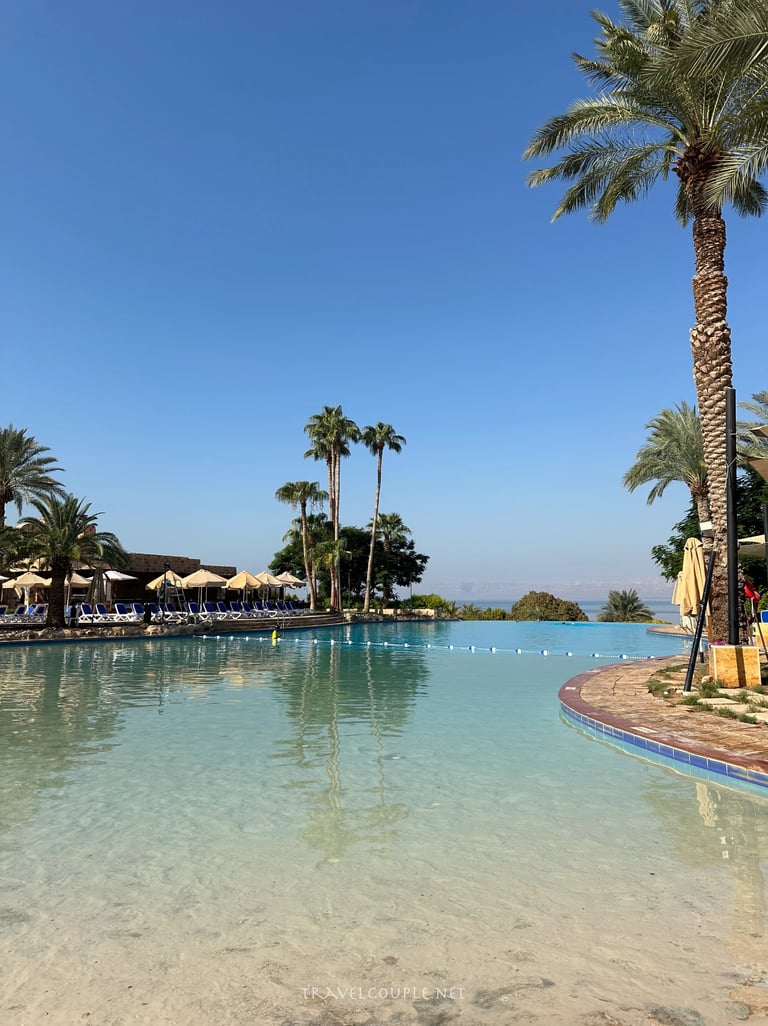
If you want the most comfortable version of the Dead Sea—private beach access, showers, sun beds, pools, spa options, open buffets and a setting where swimwear feels normal—then a resort is the easiest solution.
Day pass option (no overnight stay needed): You don’t necessarily have to book a night to enjoy the Dead Sea resort experience. Many hotels offer day passes, which usually include access to the private beach, swimming pools, and basic facilities like sunbeds and towels (what’s included varies by hotel).
In some resorts, you can also upgrade your day pass by paying extra to include an open buffet lunch or dinner (depending on the time of day and the hotel’s policy). This is the best choice if you want the comfort of a resort for a few hours without paying for a full overnight stay.
This option is ideal if you want to:
Float without worrying about facilities.
Use proper showers immediately after.
Relax by pools and treat it like a holiday day.
Do Dead Sea mud properly.
Resorts are concentrated mainly in the northern Dead Sea zone (Sweimeh area). Prices range widely, and the “5-star” label doesn’t always match expectations, so reviews matter.
What to do at the Dead Sea



2) Swim and float at salty beaches (local-style access):
Not everyone wants a resort. Many locals don’t use resorts either. There are places along the coast where people go for a quick float, a photo, and a rinse using drinking water bottles.
This is the most “raw” version of the Dead Sea:
No luxury.
Minimal facilities.
More planning needed (shoes + rinse water).
You must be respectful with clothing choices (more on that later).
We usually go to this salty beach by the end of dead sea, there a car park on the road ditch, and not that hard to get to the shore, but most important, its the most beautiful salty beach in dead sea.


3) The Pink Lake (Seasonal) + Salty Beach Stop:
The Pink Lake near the Dead Sea is a seasonal natural phenomenon where small saline pools turn pink to reddish. The color comes from salt-loving microorganisms—mainly haloarchaea and Dunaliella salina algae—that thrive in extreme high-salt water, especially when heat and evaporation increase.
Best time to visit: Summer is when the colors are usually most vivid, because high evaporation concentrates the salt and intensifies the pink tones.
How to reach it: Access is generally easy, often involving simple terrain and around a 10-minute walk from the main road.
Important: The area can sometimes have a strong sulfur smell. Don’t touch the water—these pools are highly concentrated and can irritate sensitive skin or trigger allergies.
To get there: here is the Pink Lake location, you can park on the hard shoulder of the road.
Best idea: Combine it with one of the nicest salty beach spots right in front of it, so you get two experiences in one stop: the Pink Lake photo moment + a Dead Sea shoreline float.


4) Explore water canyons near the Dead Sea (serious highlight):
One of the best surprises in the Dead Sea region is that several water canyons (wadis) are easy to access, don’t require rope work, and many are family-friendly (as long as your family is used to small adventures). They’re a perfect add-on if you want something more than just floating.
Mukheires Canyon (Family Favorite):
One of the most beautiful and family-friendly canyons in Jordan. Most of the route is easy, with one early section that needs adult supervision. You’ll also find a few small ponds where you can dip in and relax.
→ Read our Mukheires Canyon guide.
Lower Himara Canyon (Waterfall Reward):
Family-friendly for families comfortable with small-to-medium adventure. There’s a ladder mid-route that leads you onward toward a very high waterfall — the second-highest waterfall in Jordan (around 90 meters).


Upper Himara Canyon (Slightly More Challenging):
Still family-friendly, but expect some rock steps to climb up or down. It’s not dangerous, but it requires basic confidence and careful footing.
Numeirah Canyon (Easy Walk + Short Swim):
An easy walking canyon until you reach a section where you’ll need to swim around 20 meters to continue.
Attoun Canyon (Easy + Hot Waterfall):
A very easy and beautiful canyon walk, and you’ll be rewarded with a hot, steaming waterfall at the end.
Important Safety Notes (Read This):
Some canyon entrances are fenced by the government and marked as prohibited — respect signs and barriers. Or if you want to enter the canyon, enter it on your own responsibility.
Never enter canyons in winter. Flash floods are extremely dangerous and fatal accidents can happen.
In spring, always check the weather forecast (especially for Dead Sea and Madaba) and do not go if rain is expected.
Disclaimer: We share these canyon descriptions for travel information only. You are responsible for your own decisions and safety, and we are not liable for any accidents or damage — especially if entering canyons in unsafe conditions (particularly winter).


5) Go Canyoning in Wadi Mujib (Jordan’s “Grand Canyon” Adventure):
Wadi Rum gets most of the attention, but Jordan’s most famous canyoning playground is actually much closer to the Dead Sea: Wadi Mujib.
This dramatic gorge drops from the highlands down toward the Dead Sea, creating a rugged landscape of cliffs, narrow passages, and seasonal waterways that feel completely different from the rest of the region.
What makes Wadi Mujib so popular is that it delivers a real adventure without needing technical rope skills. The signature experience is a self-guided canyon route where you move through flowing water, climb over rocks, use fixed ropes for support, and push through short “obstacle” sections that are challenging in a fun way rather than technical.
The key detail: Wadi Mujib is open seasonally from April to October. Outside of that period, conditions can be unsafe and the canyon is closed.
Tickets: 23 JOD for non-Jordanians and 17 JOD for Jordanians.
Requirements: You must be at least 18 years old, and be in reasonable physical condition, as it’s an active water adventure.
Logistically, it’s very easy to add to a Dead Sea day because the visitor centre and parking are directly on the Dead Sea highway, making it one of the simplest adventure stops in Jordan if you have your own car. But if you don’t, check this Recommended Amman - Wadi Mujib tour.


6) Visit Bethany Beyond the Jordan (Baptism Site):
Even if you’re not especially religious, visiting Bethany Beyond the Jordan can be surprisingly moving. This is the internationally recognized location where Jesus was baptized by John the Baptist, and the atmosphere feels very different from Jordan’s usual tourist sites — quieter, more reflective, and full of meaning for many visitors.
For a long time, the area was difficult to access and largely absent from mainstream travel routes. Sitting close to a sensitive border zone, it only became possible to properly protect, develop, and welcome visitors after Jordan’s modern political changes in the 1990s.
Since then, it has grown into one of the region’s most important Christian pilgrimage destinations, receiving visits from major world figures and gaining global recognition, including UNESCO World Heritage status (2015).
Logistically, it’s also an easy add-on: the site is roughly 25 minutes from the Dead Sea, so you can visit it as a half-day trip if you’re staying overnight at the Dead Sea, or combine it on the same day as a float and a sunset viewpoint.
You may check this private tour in Dead Sea area that includes Baptism site stop.
Tickets: Bethany Beyond the Jordan is not included in the standard Jordan Pass. If you buy the Jordan Pass in advance, you can usually add Bethany as an optional extra (commonly around 8 JOD). Otherwise, you can buy tickets on-site at the ticket office (commonly around 12 JOD).


7) Enjoy Sunset at Panorama Dead Sea Complex:
If you want one of the easiest “wow” viewpoints in the Dead Sea region, Panorama Dead Sea Complex is the one. It sits high above the shoreline, so you get a wide open view across the salt flats and the Dead Sea itself — and on a clear day you can even see across to the opposite side.
It’s especially popular around sunset, when the light turns the whole valley warm and golden and the water starts to reflect like metal.
There’s a small viewing platform, a Dead Sea Museum on-site (with exhibits explaining the geology, environment, and why the sea is shrinking), and a short marked walk known as the Zara Cliff Walk (around 1.4 km) if you want to stretch your legs before or after sunset.
There’s also a restaurant/café at the complex — it’s convenient if you want a drink or have a meal with a view, but the main reason to come is the viewpoint itself, not gourmet dining.
Tickets & opening times: Entry to the viewpoint area is typically 2 JOD per person and includes museum access. Opening hours can change seasonally, but as a general guide the museum operates roughly 9am–5pm in summer and 8am–4pm in winter, while the viewpoint/restaurant stays open later into the evening (often until around 10pm–11:30pm, depending on season).
Tip: If you plan to eat here at sunset, reserve in advance when it’s busy (weekends and holidays), and arrive a bit early so you get a good spot before the crowds.


8) Relax at Ma’in Hot Springs — Or Think Twice:
Ma’in Hot Springs (Hammamat Ma’in), tucked into the hills above the Dead Sea, is one of those places that sounds perfect on paper: hot mineral waterfalls, steamy pools, and a “spa reset” after days of walking Petra or getting battered around in the back of a desert 4x4.
It’s also close enough to combine with a Dead Sea day, especially if you’re coming down from Madaba — which makes it very tempting if you want something relaxing that still feels unique and natural.
Ma’in is part of the Ma’in Hot Springs Resort, so you can visit on a day trip from Madaba with a day pass. As a rough guide, the public pools are often around 15 JOD for foreign visitors, and the hotel spa pools closer to 38 JOD (always check current rates). You can also stay overnight at the resort — check the latest room prices here in the only hotel available there.
For years, Ma’in was genuinely one of the most talked-about “treat yourself” stops in Jordan. You could visit as a day trip by paying for access to the public thermal pools, and there are also more private, hotel-style facilities if you want a calmer experience.
But here’s the honest part: the experience at Ma’in today can be very hit-or-miss depending on timing, crowd levels, and who is there that day. In particular, recent visitor feedback across reviews has been pointing out that the atmosphere can sometimes feel uncomfortable — especially for women — when large groups gather in the pools and the setting becomes less of a relaxing “hot springs” moment and more of a crowded hangout, because of that, we don’t recommend Ma’in blindly anymore.
If you really want to go, you still can have a good experience — but do it smart: check the most recent reviews, avoid peak times and weekends if possible, and choose the option that gives you the level of privacy you’re comfortable with. Ma’in has the potential to be a beautiful stop… but it’s not guaranteed, and it’s better to go informed than disappointed.


9) Visit Madaba and Mount Nebo before heading down:
Rising high above the Dead Sea valley, Mount Nebo is one of Jordan’s most important Christian sites and one of the best viewpoints in the region.
According to tradition, this is where Moses was shown the Promised Land, and the landscape still delivers that dramatic sense of distance: dry hills rolling outward, the valley dropping away, and the horizon stretching far beyond what you expect.
The site has been a place of pilgrimage for centuries. Early Christians came here from Jerusalem, and a church was built to commemorate the mountain’s significance.
While the complex has been restored and developed over time, the atmosphere remains quietly powerful—especially in late afternoon light when the valley looks almost endless.
Even if you’re not religious, Mount Nebo is still worth it. Inside the basilica, you’ll find remarkable mosaics that are among the best-presented you’ll see in Jordan, and the combination of history and viewpoint makes it more than a quick photo stop.
To make the most of the area, pair Mount Nebo with Madaba—the nearby “City of Mosaics.” Madaba is known for its churches and cathedrals, most famously St. George’s Church, where you can see the famous mosaic map, plus several other historic religious sites and beautifully preserved mosaic floors.
We loved our visit to St. John the Baptist Roman Catholic Church. It’s worth a stop because it’s not just “another church” — you can climb up to the bell tower for panoramic views over Madaba, and visit the underground vaulted areas beneath the complex, which include an on-site museum and a very old well tied to the area’s ancient past. It’s an easy add-on to a Madaba walk and pairs perfectly with your church-and-mosaics route before heading down to the Dead Sea.
It’s an easy, logical route: Madaba and Mount Nebo in the highlands, then the dramatic drive down toward the Dead Sea.


Let’s start with not to do: You don’t “swim” in the Dead Sea the normal way، if you try breaststroke, your legs pop up, your head dips, and you get a face full of salt water that you will remember forever in a bad way.
So here’s how to float safely and enjoyably:
Float on your back, slowly: The simplest way is the best: lie back slowly, keep your head up, and let the water do the work. Don’t fight it.
Keep water away from eyes and mouth: It hurts. It’s not dangerous in tiny accidental amounts, but it’s extremely unpleasant. If it happens, rinse immediately with clean water.
Don’t shave right before: Fresh shaving creates micro-cuts you can’t see. The Dead Sea will find them. Give yourself 2–3 days if possible.
Tips for floating in the Dead Sea (do this right):


Cover cuts (if you must): If you have small cuts, waterproof bandages help, but nothing is perfect. Expect some stinging if you have open skin.
Wear water shoes: Dead Sea salt formations can be sharp and unforgiving. Shoes are not optional unless you enjoy pain.
Don’t stay in too long: A common guideline is 10–15 minutes in the water at a time. You can go in again later, but don’t “marinate” in it.
Rinse properly (especially sensitive areas): This matters. Rinse thoroughly, not just “a quick splash.” Salt crystals cling and sting.
Protect your phone and valuables: Salt gets into everything. Keep your phone sealed, and clean it after. Avoid bringing expensive tech down to the water unless protected.


Free Dead Sea access exists, but it’s not always obvious and not always comfortable.
Some stretches of shoreline are fenced, private, or simply hard to access. When you find a free spot, you’ll usually get:
a rough parking area.
a walk down.
sharp salt formations.
minimal facilities (or none).
What you MUST bring for free spots:
4L of water for rinsing per person.
Wet shoes.
Towel + change of clothes.
Plastic bag (for trash and wet swimming wear).
A note about comfort and culture:
At free local spots, swimwear expectations are different than resorts. If you’re a woman, a bikini at a local free spot can attract unwanted attention. A more conservative swimsuit + cover-up is the smarter option.
We are not saying this to be “polite”—I’m saying it because it affects whether you actually enjoy the experience.
Free swimming spots in the Dead Sea (what to expect)


The Dead Sea looks simple on a map because it’s close to Amman — but your actual experience depends on which access point you choose, whether you want resorts or free swimming spots, and whether you’re combining the visit with canyons or viewpoints.
Here are the main ways to get there:
1) By rental car (best for flexibility): If you have a car, you have total freedom — the Dead Sea becomes easy. You can choose your shoreline spots, add stops like Panorama Dead Sea Complex, detour to nearby water canyons, and continue south toward Karak, Petra, or Aqaba. For the full details, read our guide: Renting a Car & Driving in Jordan.
2) By bus tour (best if you don’t want to drive): If you’re not renting a car, a tour is usually the easiest option because public transport to Dead Sea areas is limited and not tourist-friendly. The downside is that tours follow a fixed route and fixed stop points, so your experience is more limited.
If you want an organized option, you can check JETT tours for Dead Sea trips — for example, their Madaba → Dead Sea → Baptism Site tour typically stops in the hotel/resort zone at the Dead Sea. That usually means your Dead Sea time will be spent at one resort of your choice, and you’ll need to purchase a day pass at that hotel to access the beach/pools.
If you don’t want to drive, but still be alone and not with a group, the easiest option is a guided trip—here’s a well-reviewed Madaba + Mount Nebo + Dead Sea day tour.
3) By taxi or private driver (less common, most expensive): This option can work well, but it’s usually the most expensive — especially if you’re traveling solo — and it requires research to find a reliable driver. You also need to agree in advance on where to stop, how long the driver will wait, and the total price.
As a rough reference, prices typically start from around 50 JOD and go up, depending on the tour type, distance, duration, number of stops, and whether it’s a simple transfer or a full-day private itinerary.
Money-wise, it’s best for couples or families who want flexibility without driving. If you want, you can check this private tour option.
How to get to the Dead Sea (and why it confuses people)


While the luxury hotels along the Dead Sea shore are the most famous option — and honestly, many people think they’re the only way to sleep in the area — we’re here to show you that you have cheaper alternatives, and some of them even come with a swimming pool.
For us as a travel couple, it’s essential to share options that match different tastes and budgets, especially for travelers who want to sleep in the Dead Sea region to enjoy the full experience of this magical place without feeling forced into one expensive choice.
(For a full accommodation breakdown across the whole country, see Where to Stay in Jordan).
Option 1: Luxury resorts (private beach + pools + spa): The classic Dead Sea experience is staying in one of the big resort hotels with private beach access. This is the most famous option — and usually the most expensive — but it’s the easiest if you want maximum comfort and a full resort vibe.
You’ll typically get swimming pools, towels, changing rooms, beach access, and the convenience of staying right by the water. Many resorts also offer open buffet meals and spa services, which is great if you want to switch off and relax completely. Prices depend on the hotel and season, but generally start from around 70 JOD per night and go up.
Option 2: Rent a chalet with a swimming pool (Sweimeh town): This is one of the most fun options — especially if you have kids and want full privacy. These chalets are usually owned by locals, and many are spacious enough for two or even three families staying together.
Most come with a private swimming pool, an equipped kitchen, and indoor/outdoor seating areas, so you can turn it into a full “weekend-style” stay instead of just one quick dip in the sea. The only thing you need to plan is your meals and what you want to cook. Prices vary by size and season, but many start from around 80 JOD per night.
Option 3: Budget hotels in Sweimeh town: If you’re traveling on a tighter budget, there are also budget hotels in and around Sweimeh with reasonable prices. Don’t expect a luxury resort style — these places are simple — but they can be comfortable enough for a night, and they keep you close to the Dead Sea area without spending big.
Most are not beachfront, but still within a short drive. Prices typically start from around 30 JOD per night.
Option 4: Airbnb in Madaba (smart base): One of the smartest strategies — especially if you’re landing at Queen Alia Airport and don’t want to overspend on your first nights — is staying in Madaba.
You’ll usually find cheaper accommodation than the Dead Sea resorts, and you’ll be close to both Amman and Madaba’s historic sites, while still being able to do easy day trips down to the Dead Sea. Madaba also gives you a calmer base if you prefer not to stay inside the resort zone.
Where to Stay at the Dead Sea (Options for Every Style & Budget)


If you’re asking this question, you’re probably thinking: “It’s famous, but is it actually worth it?”
Here’s our honest answer: yes—for most travelers.
Not because it’s the most “fun” place in Jordan, but because it’s one of the most unique experiences you can have on Earth. There are only a few places globally that feel genuinely like a natural phenomenon rather than “just another attraction.”
That said, if your trip is extremely short and you have to choose between: Petra, Wadi Rum, Dead Sea. Then Petra and Wadi Rum usually win.
But if you have even a little flexibility, the Dead Sea is absolutely worth including—especially because it combines so well with Madaba, canyons, and road-trip routes south.
Is it necessary to visit the Dead Sea at all?
The Dead Sea is already under pressure from shrinking water levels and environmental change. The least we can do as visitors is not make it worse.
When you visit, please:
Take your rubbish with you (bring a bag, don’t rely on bins).
Do not light bonfires on the white salty beaches.
Do not destroy salt formations for photos.
Do not take large amounts of salt rocks and salt sand as souvenirs.
If you see litter, pick up what you can—small effort, big difference.
This place is not a theme park. It’s a fragile natural wonder, and it deserves basic respect.
Our message to you: keep the Dead Sea clean
Get in touch


Home | Jordan | Blog | Services | About | Contact | Privacy Policy | Terms of Use | Refund & Payment Policy
© 2026 Travel Couple